It Hasn’t Expired. So Why Can’t I Ship It?
Most businesses track expiry dates. Few actively manage the decisions that expiry creates.
In FMCG supply chains, inventory can be available, compliant, and still not be eligible for shipment. The challenge isn’t knowing when a product expires, it’s knowing what actions to take before it gets there.

In FMCG, a product being within its expiry date doesn’t always mean it is ready to ship.
A batch may still be sitting safely in the warehouse, but its remaining shelf life could make it unsuitable for a particular customer, channel, or order.
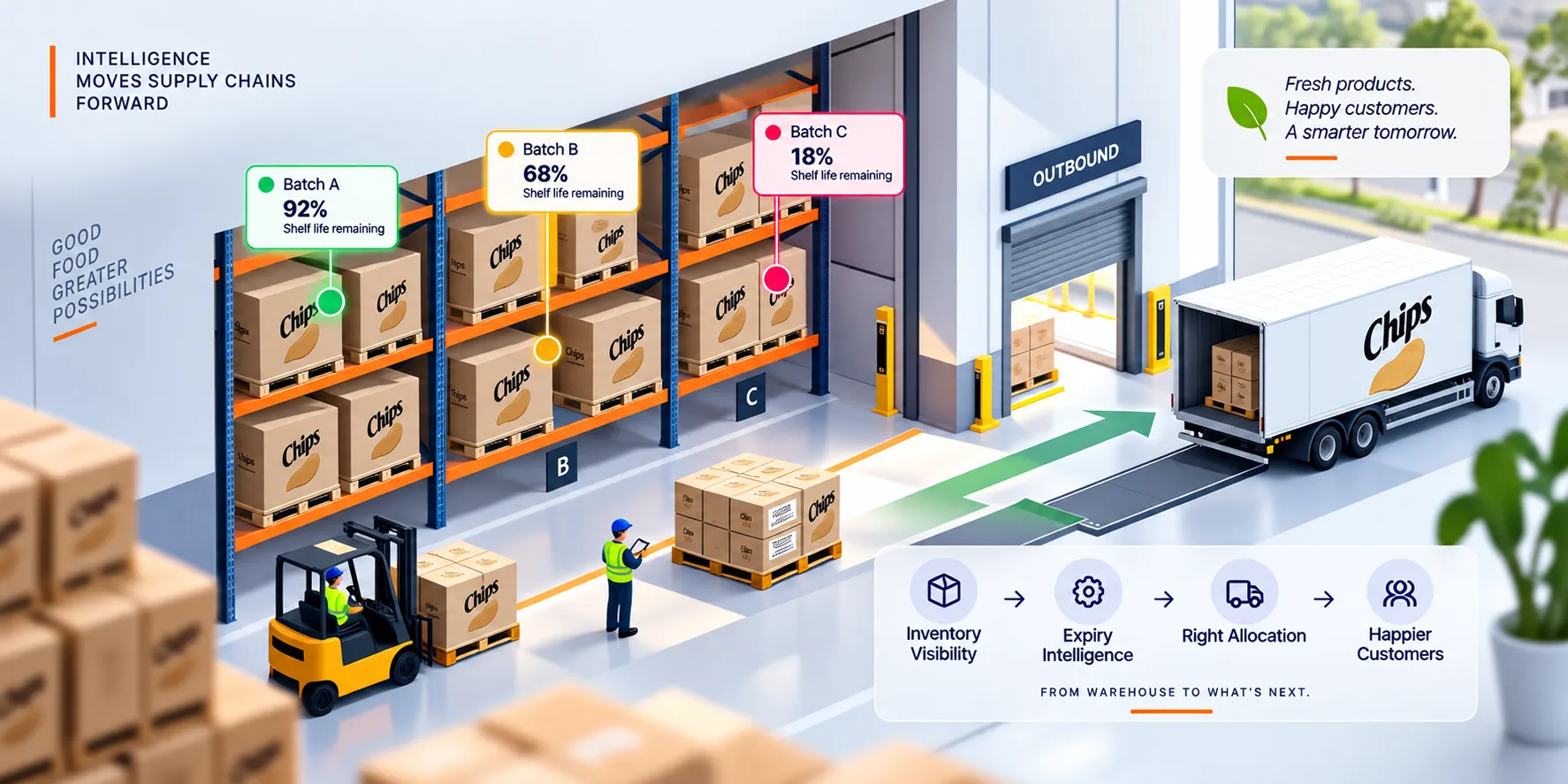
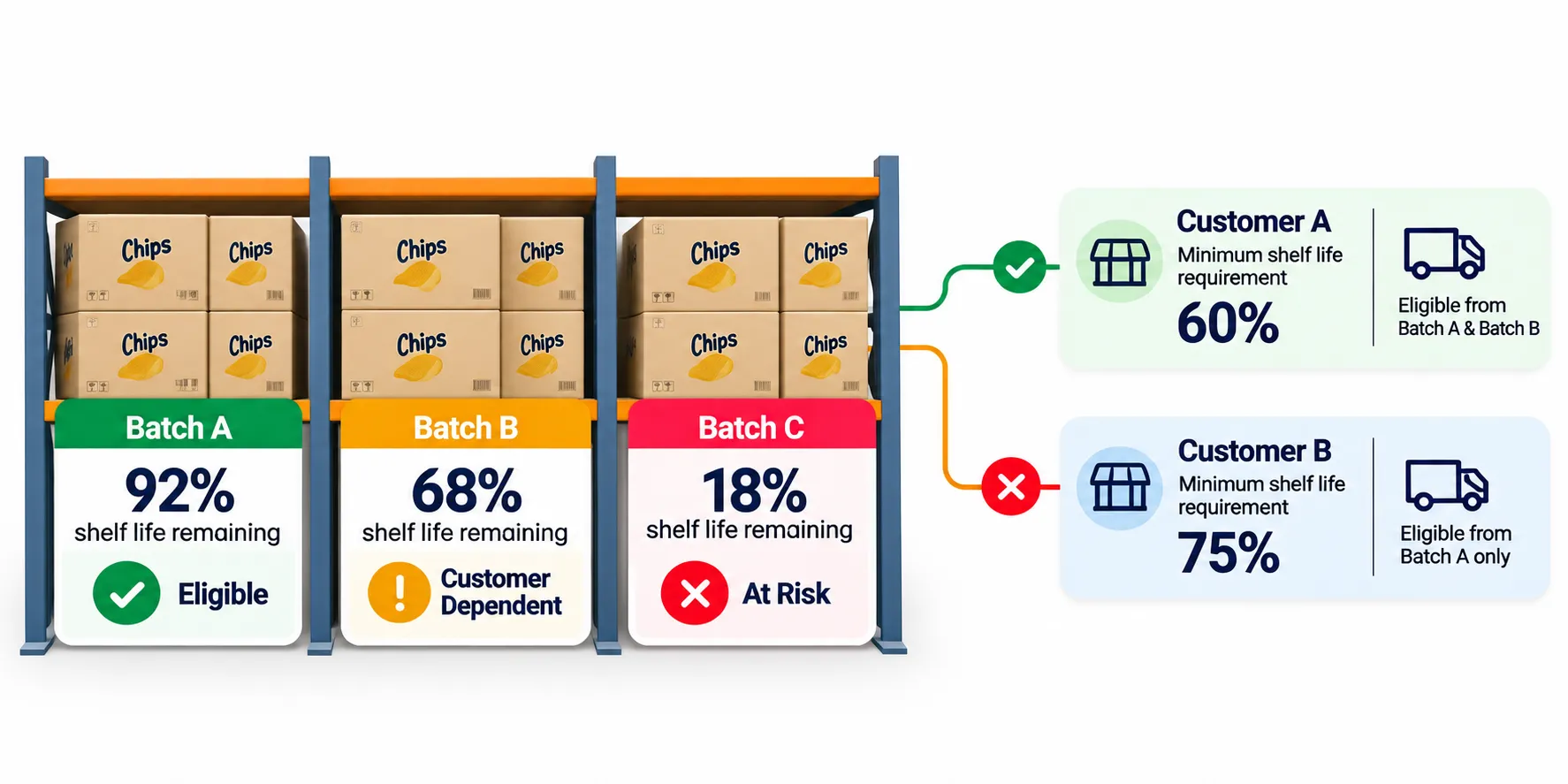
Imagine three batches of the same product:
- Batch A: 92% shelf life remaining → Eligible
- Batch B: 68% remaining → Eligible for some customers
- Batch C: 18% remaining → May not meet customer requirements
The quantity hasn’t changed.
But the usability of that inventory has.
And that is where expiry becomes more than a date on a label.
Expiry Is a Business Rule
Different customers can have different minimum shelf-life requirements.
A batch with 68% of its shelf life remaining might be perfectly acceptable for one customer but fall short of another customer’s requirement.
So when an order arrives, the question isn’t simply:
“Do we have the stock?”
It is:
“Do we have stock that is still eligible to fulfil this order?”
That requires the business to connect several pieces of information:
SKU + Batch + Expiry + Customer + Shelf-life Rule + Quantity
When these are considered together, inventory availability becomes more meaningful.
Because available inventory and shippable inventory are not always the same thing.
The Real Expiry Problem Happens Before Expiry
A product doesn’t suddenly become risky on its expiry date.
It gradually moves from:
Fresh → Aging → At Risk → Expired
The earlier the business recognises that movement, the more options it has.
An aging batch can be prioritised for dispatch.
A customer or channel that still accepts the remaining shelf life can be identified.
Inventory can be allocated differently.
Sales can be alerted while there is still time to act.
But if expiry is monitored only through periodic checks or manual intervention, these decisions can happen too late.
The challenge is not storing the expiry date.
The challenge is turning that expiry date into an action.
This Is Where TriSys Adds the Intelligence Layer
Most businesses already have systems that contain valuable inventory information.
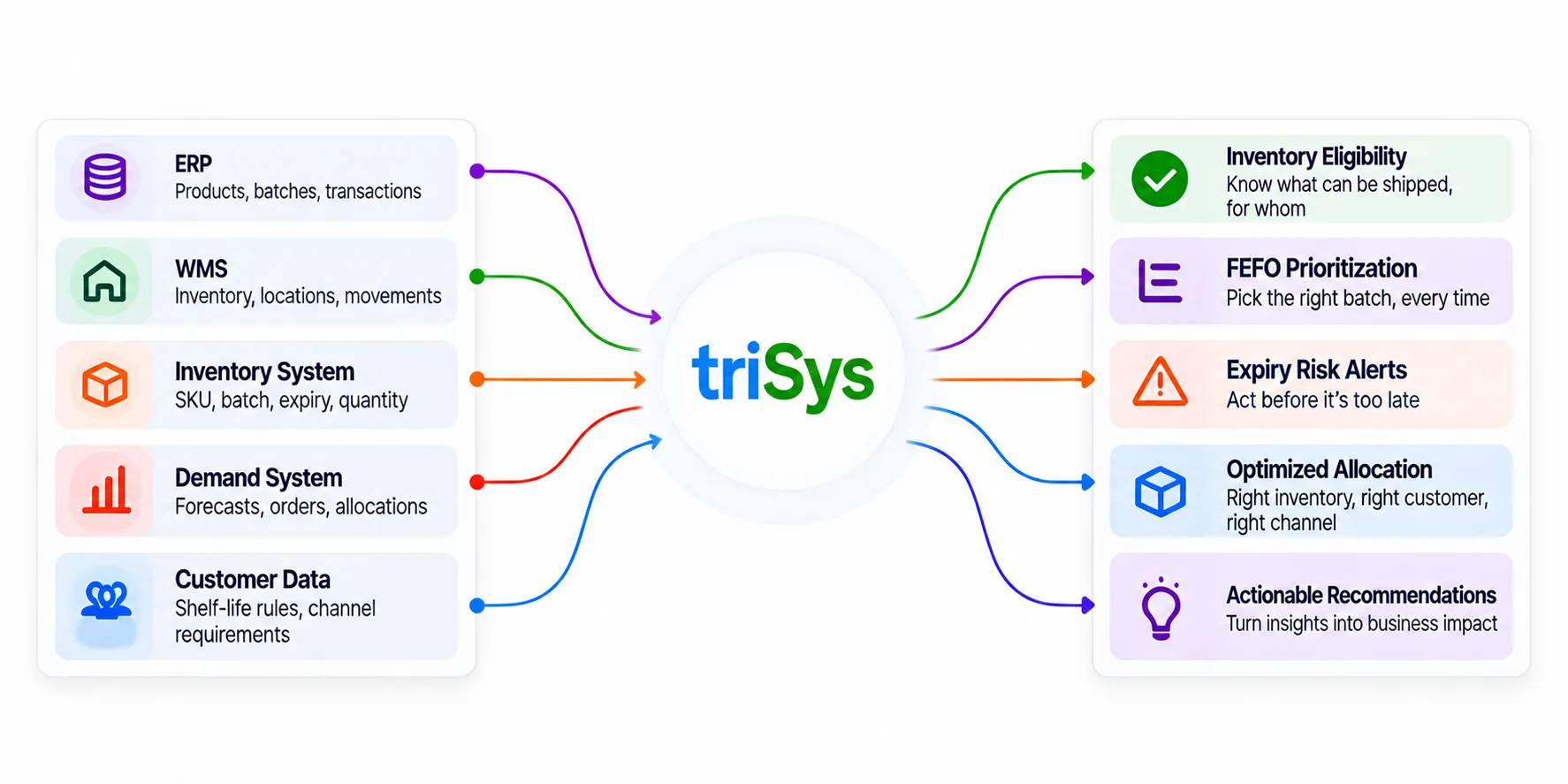
Your ERP or WMS may already know:
SKU | Batch | Quantity | Expiry | Location | Inventory Status
The problem is that this information doesn’t automatically answer the business question:
“What should we do with this inventory now?”
TriSys works as an AI-powered intelligence layer that can work with the data already available in the business systems.
It brings together:
- Customer-specific shelf-life rules
- Batch and expiry information
- Inventory aging
- FEFO priorities
- Order and allocation requirements
- Early expiry-risk signals
And uses that information to help move from visibility to action.
From “What Do I Have?” to “What Can I Ship?”
Consider a simple example.
The system sees:
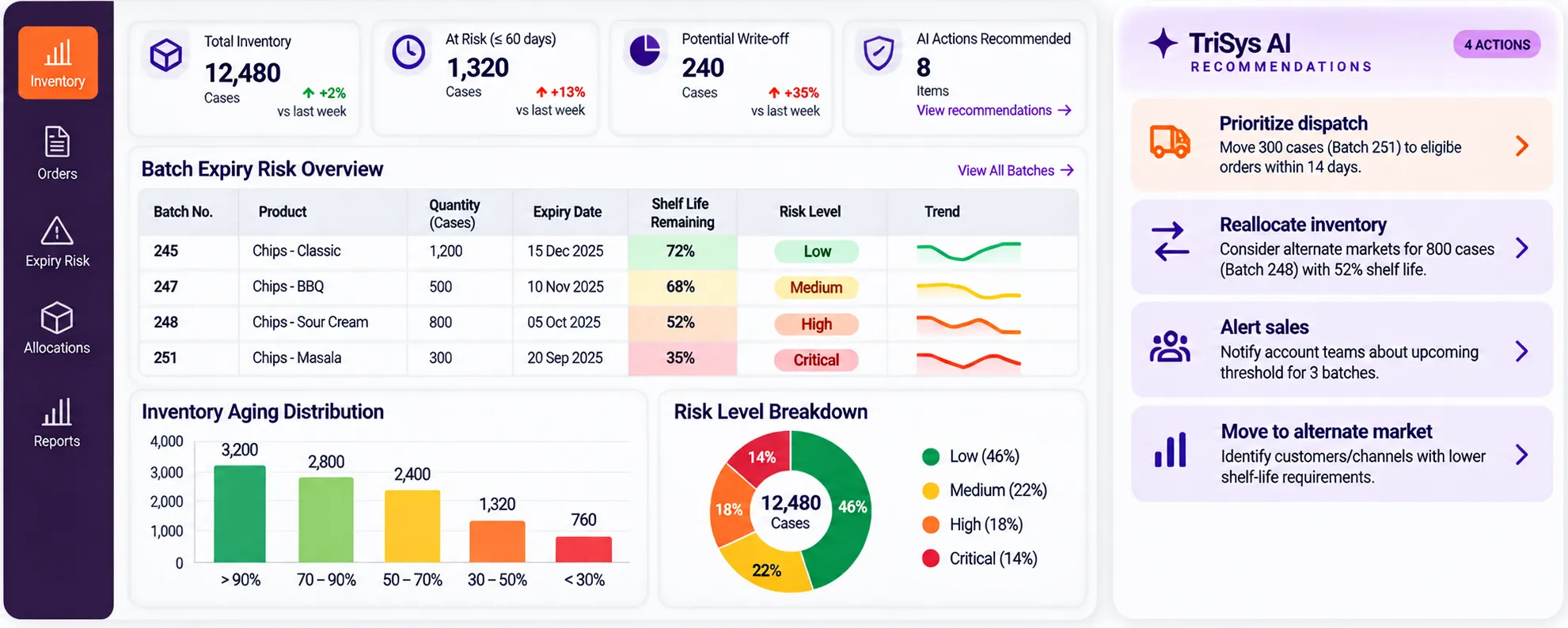
Batch 247 68% shelf life remaining 500 cases available
A traditional inventory view may stop there.
TriSys can add the context around that number.
Customer A Required shelf life: 60% → Eligible
Customer B Required shelf life: 75% → Not eligible
Inventory status Approaching allocation risk → Review / prioritise
Now the expiry date is no longer just information.
It is part of the decision.
FEFO Becomes More Meaningful
Expiry-aware inventory also changes how products should be picked.
With FEFO — First Expiry, First Out — the batches with the earliest expiry can be prioritised for dispatch. This helps prevent newer stock from being shipped while older stock continues to age in the warehouse.
But FEFO alone doesn’t answer every question.
The earliest-expiring batch may not be eligible for the customer placing today’s order.
So the system needs to consider both:
What expires first?
and
What is eligible for this customer?
That is where the value of connecting expiry with business rules becomes clear.
Don’t Wait for the Threshold to Be Crossed
The most valuable expiry alert isn’t necessarily: “This product is now at risk.”
It is: “This product is likely to become at risk soon.”
TriSys’s proposed intelligence layer can move toward predicting which batches are likely to cross a configured shelf-life threshold before expected sell-through.
That gives the business time to respond.
The system can help identify potential eligible customers, retail markets or locations based on shelf-life and demand rules. It can also suggest possible actions such as prioritising dispatch or transferring inventory, with Sales approval before execution.
The objective is simple:
Act while the inventory still has options.
From Expiry Tracking to Expiry Management
There is a big difference between the two.
Expiry tracking tells you:
This batch expires on this date.
Expiry management helps answer:
Is this batch still eligible? Who can receive it? Should it be picked first? Is it approaching risk? Who needs to know? What action should happen next?
That is the value TriSys is bringing to the process.
Not another place to store inventory data.
Not another dashboard that simply displays expiry dates.
An intelligence layer that connects the expiry date to the decisions around it.
The Goal Isn’t to Manage Expiry at the Last Minute
By the time a product expires, the business has already lost most of its options.
The opportunity is much earlier.
When a batch is:
Fresh → keep it moving normally.
Aging → consider FEFO and allocation.
Approaching a customer threshold → identify where it can still go.
At risk → alert the right team and recommend the next action.
Expired → the decision window is already closed.
TriSys is designed to help move that decision window earlier.
Because in FMCG, having 100 cases in inventory doesn’t necessarily mean you have 100 cases ready to ship.
The more important question is:
Do you know which inventory is actually shippable, and which inventory needs action before it is too late?
About TriSys
TriSys IT Services is an AI-powered warehouse and supply chain technology company helping businesses transform their warehouse operations. We add an intelligence layer to existing WMS and ERP platforms—bringing together AI, automation, and connected data to improve inventory visibility, workforce productivity, space utilization, fulfillment efficiency, and operational decision-making without replacing the systems already in place.
Learn more at www.trisysit.com.